The Unbreakable Truth About Borosilicate Glass
Ever wonder what separates a quality bong from a fragile drinking glass you'd find at a dollar store? It all comes down to the science. Think of regular glass—the stuff they call soda-lime glass—as that flaky friend who's only around for the good times. It’s totally fine when everything is chill, but hit it with a little stress, like a blast of hot water during cleaning, and it throws a fit and cracks.
Borosilicate glass is your ride-or-die. It’s got a secret ingredient, boron trioxide, which completely changes its game on a molecular level, giving it a personality that’s much less… shattering. This is why it doesn't freak out from thermal shock—that's just the fancy term for glass cracking when the temperature changes too fast. It's the same reason a beaker in a science lab doesn't explode and why your good pipe can take a serious cleaning without a meltdown.
Stronger, Clearer, Better
But its toughness isn't just about handling heat. Borosilicate glass is also mechanically a whole lot stronger. I'm not saying it's invincible—don't go juggling your bongs—but it can definitely shrug off minor drops and bumps that would absolutely demolish its soda-lime cousin. That kind of resilience means your investment is protected, saving you the heartache of watching a favorite piece bite the dust.
The bottom line is this: Borosilicate glass gives you peace of mind. It’s a material made for performance, whether it’s in a lab or on your coffee table. You’re getting a piece that’s tougher, safer, and just plain built to last. It's clearly superior.
- Winstoned Churchillikethat
This simple table really breaks down why one type of glass reigns supreme in our world.
Borosilicate vs Soda-Lime Glass: A Clear Winner
| Feature | Borosilicate Glass (The Champ) | Soda-Lime Glass (The Contender) |
|---|---|---|
| Heat Resistance | Excellent; handles rapid temperature changes without cracking. | Poor; prone to shattering from thermal shock. A real drama queen. |
| Durability | Mechanically stronger and more resistant to impacts. | Brittle and easily chipped or broken. Basically made of potato chips. |
| Clarity | Crystal clear and non-porous. | Less clear and can become cloudy over time, like a bad memory. |
| Chemical Resistance | Highly resistant to chemicals, won't leach anything nasty. | Less resistant, can degrade with certain cleaners. |
| Common Use | High-quality bongs, pipes, lab equipment, premium cookware. | Window panes, bottles, cheap drinkware. Basically, things you look through, not at. |
It's pretty obvious why we stick with boro. You're just getting a fundamentally better, more reliable material for your gear.
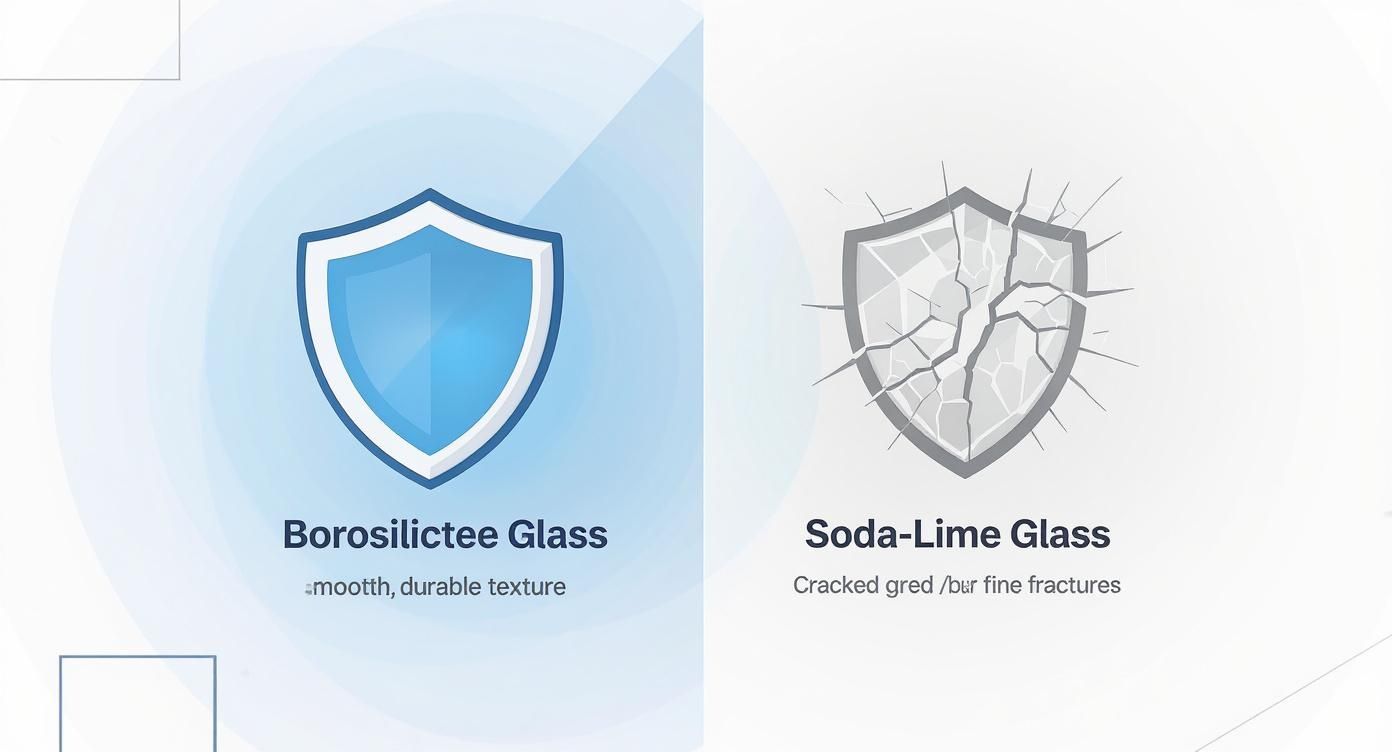
This image says it all. You can see why borosilicate is the go-to for any quality smoking accessory—it’s made to resist the exact kinds of stress that destroy lesser glass. It's not just a piece, it's peace of mind.
This extra durability should extend to every part of your setup, not just the main chamber. Even accessories like an unbreakable aluminum downstem are built on that same principle of prioritizing strength for a better, more reliable experience. When you choose borosilicate, you’re not just buying a piece of glass; you're investing in something you can actually count on.
The Secret Recipe That Makes Borosilicate So Tough
So, what’s the secret sauce that gives borosilicate glass its legendary status in the smoking world? It’s not some kind of alchemy, but it's pretty darn close. The magic ingredient is boron trioxide, a compound that completely flips the script on how glass handles heat. We're not saying it's a boron star, but... okay, we are.
Imagine regular soda-lime glass is like a cheap, stiff t-shirt. Sure, it works, but the moment you put any real stress on it, the seams rip. Borosilicate glass, on the other hand, is like adding a dose of high-quality spandex to the fabric. That bit of stretch gives it incredible flexibility and resilience, letting it snap right back into shape. Boron trioxide is the "spandex" for glass, giving it a molecular structure that can roll with the punches.
Taming Temperature Tantrums
This is where things get a little nerdy, but hang in there—it’s the whole reason your good bong doesn’t explode. Every material on earth expands when it gets hot and shrinks when it gets cold. The measurement of how much it does this is called its coefficient of thermal expansion.
Soda-lime glass has a super high coefficient. That means it freaks out with temperature changes, expanding and contracting like a panicked accordion. This internal stress is exactly what makes a cold pipe crack when you hit it with hot water. The glass is basically having a meltdown.
Borosilicate glass boasts a very low coefficient of thermal expansion, roughly one-third that of standard glass. This means it barely expands or contracts, allowing it to shrug off extreme temperature changes without breaking a sweat—or, you know, shattering into a million pieces.
- Winstoned Churchillikethat
This incredible stability is why you can confidently clean your favorite piece with steaming hot water. Its chemical makeup keeps it calm and collected, preventing the kind of catastrophic failure that plagues cheaper glass. The global market for borosilicate glass was valued at around USD 2.94 billion and is expected to hit USD 4.67 billion in the next decade, which just goes to show how vital this tough material is. You can read more about the borosilicate market growth on reportsanddata.com.
The Science Behind the Strength
It all boils down to the bonds holding the molecules together. Adding about 13% boron trioxide to the silica mix creates a much tighter and more stable atomic structure. This reinforced molecular grid doesn't just resist heat; it also makes the glass itself stronger, giving it better odds against those accidental bumps and drops. It's a bond stronger than your friend group after a music festival.
This superior heat handling is also why it's a must-have for accessories that take a torch head-on. A high-quality piece like a GRAV® Quartz Angled Banger is built on these same principles of thermal strength to give you consistent dabs without cracking under pressure. It's this smart chemistry that elevates a simple piece of glass into a reliable tool for your sessions.
Why Your Glass Should Be Borosilicate
We've gone through the science, but how does that translate to your actual smoke sessions? It's pretty straightforward, really. Knowing your piece is borosilicate isn't just a talking point; it's about making your whole experience better, from setup to cleanup.
Think of it like using a solid ceramic plate versus a flimsy paper one. Sure, they both hold food, but you only trust one of them not to collapse on you. This is where the real-world advantages come into play, turning all that lab talk into perks you’ll notice every single day.
The Thermal Shock Trooper
We’ve all had that moment. Your piece is gross, you're out of isopropyl alcohol, and you think, "I'll just blast it with hot water." If you're using cheap soda-lime glass, that's a surefire way to hear a heartbreaking crack and send your beloved pipe to a watery grave. That sudden break is called thermal shock, and it's the number one killer of regular glass.
Borosilicate glass just laughs at thermal shock. Its super low thermal expansion means you can go from a cold-water session to a hot water rinse without even thinking about it. It can handle wild temperature swings of up to 330°F (166°C), which makes your cleaning routine way faster, easier, and a lot less stressful.
This isn't just some minor feature; it's freedom. The freedom to clean your piece the right way without basically playing Russian roulette with its life. It's the difference between a quick, satisfying wash and a tragic, shattered mess.
- Winstoned Churchillikethat
Durability for the Rest of Us
Let's be real, accidents are a part of life. A clumsy friend, a flick of the wrist, a cat with zero respect for your belongings—the world is full of things that want to break your glass. While boro isn't indestructible (so please don't test it on the concrete), it's way more durable and impact-resistant than its fragile cousin.
-
Chip Resistance: The surface is harder, so you’re less likely to get those annoying little dings and chips around the mouthpiece or the joint.
-
Drop Survival: It has a much better shot at surviving a short fall onto a rug or a bump against the coffee table.
-
Sturdy Joints: Good borosilicate pieces have clean, thick welds where parts connect (like where the downstem meets the base), which are usually the first things to snap on cheap glass.
That extra toughness saves you cash and the gut-wrenching pain of watching a favorite piece die. It’s a buffer against everyday life, turning a potential disaster into just a minor "oops."
The Search for Pure Flavor
Ever take a rip and taste something... a little off? That weird, funky flavor might actually be your glass. Standard soda-lime glass can be slightly porous, which means it hangs onto old resin, residue, and even cleaning chemicals that mess with the taste of your fresh flower. It's like the ghost of sessions past.
Borosilicate glass is completely non-porous and chemically inert. Its slick, smooth surface doesn't trap old gunk or leach weird flavors into your smoke. Every hit tastes exactly how it's supposed to—clean, pure, and untainted. You get the full terpene profile of your flower or concentrates, not the ghost of last week's sessions.
This is super important for anyone who wants to fully appreciate what a bong is designed to deliver: a smooth, flavorful experience. Going with boro makes sure your material, not the memory of old resin, is the star of the show.
How to Spot Real Borosilicate in the Wild
Trying to navigate the glass market can feel like you’re on a safari, attempting to tell a majestic lion from a house cat in a wig. Not all glass is created equal, and some shops will absolutely try to pass off cheaper, weaker stuff as the real deal.
This is your field guide for spotting authentic borosilicate and avoiding those fragile imposters.
First off, let's just talk about the vibe. Real borosilicate has a certain heft to it, a reassuring density that cheap soda-lime glass just can't fake. It's not about being clunky, but about feeling substantial in your hand.
If you pick up a piece and it feels suspiciously light or flimsy—almost like a cheap wine glass—you should be skeptical. High-quality boro has a solid presence that feels like it was built to last, not shatter if you happen to sneeze in its direction.
Become a Glass Detective
To really get down to it, you need to channel your inner Sherlock Holmes and look for the clues.
Start with the branding. Reputable artists and companies who use genuine borosilicate are proud of that fact. Look for brand logos, artist signatures, or small stamps etched discreetly somewhere on the piece. A total lack of any identifying marks can be a red flag.
Next, give the piece a good, hard look.
-
Check for Clarity: True borosilicate glass is known for its incredible, almost brilliant clarity. It should look crystal clear. Any fogginess, weird bubbles, or distortions in the glass itself are bad signs.
-
Examine the Welds: Look at the joints where different parts connect, like where the downstem holder meets the base. On a quality piece, these welds will be clean, thick, and seamless. Messy, thin, or lumpy joints are a classic sign of shoddy craftsmanship and, most likely, cheaper glass.
-
Feel the Thickness: While designs obviously vary, most borosilicate pipes and bongs are made with glass that's at least a few millimeters thick, especially at the base and joints. Glass that feels thin and delicate just isn't going to have the durability boro is famous for.
One of the most reliable giveaways is the craftsmanship. Smooth, uniform walls and strong, clean joints don't happen by accident. They're the mark of an artist or company that invests in high-quality materials and has the skills to work them properly.
Trust Your Instincts
Ultimately, buying glass is about trust. Do your homework on the brand or the artist. A little online sleuthing can tell you a lot about their reputation and the materials they swear by.
High-end brands known for complex designs almost always use borosilicate because they need its reliability. A perfect example is the intricate construction you see in official replacement parts like the Puffco Peak Replacement Glass 2.0, where precision and durability are completely non-negotiable.
The unique properties of borosilicate also change how it can be worked. For instance, artists often choose a specific type of glass based on how well it takes fine detail; you can learn more about how to engrave glass and see what's needed for that kind of work.
And remember, if a deal seems too good to be true, it probably is. Authentic borosilicate costs more to make, so a bargain-bin price is a major warning sign. Don't get glass-lit.
Caring for Your Borosilicate Best Friend
Alright, so you've got a quality piece. Let's make sure it has a long, happy, and ridiculously clean life. The good news? Caring for borosilicate glass is less of a chore and more of a victory lap, all thanks to its killer properties. Unlike that cheap, fragile soda-lime glass, boro isn’t afraid of a little hot water—in fact, it pretty much welcomes it.
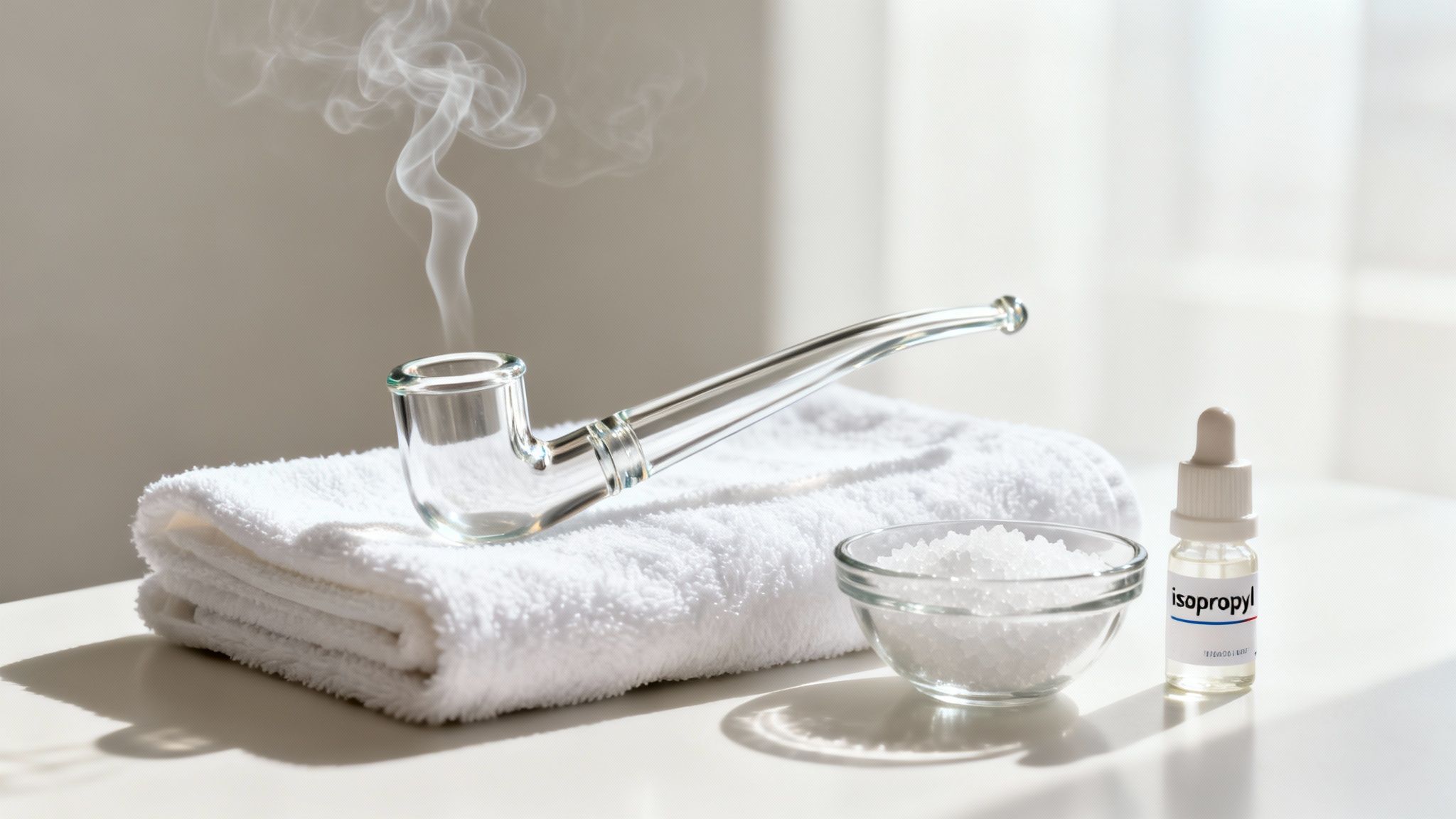
That thermal resilience is your secret weapon against stubborn, caked-on resin. A good rinse with hot (not boiling!) water can loosen a surprising amount of gunk before you even get to the main event. Think of it as a simple pre-soak that makes the real cleaning way, way easier.
The Cleaning Playbook
When it’s time to get serious, the classic combo of isopropyl alcohol (91% or higher) and coarse salt is still the undisputed champ. This one-two punch works like a microscopic scrub brush, dissolving all that sticky resin while the salt physically scours away the tough spots.
-
First, dump out the old water and give the piece a quick rinse with warm water.
-
Toss in a generous amount of coarse salt—Epsom or sea salt works great.
-
Pour in enough isopropyl alcohol to swish around and get everything moving.
-
Plug up the holes and shake it like you mean it. Seriously, put some elbow grease into it. It's a workout for you and a spa day for your bong.
-
Safely dispose of the isopropyl alcohol by diluting it with 20 parts water to 1 part alcohol before dumping it down the drain or save it and take it to a proper disposal facility. Check your local laws to make sure you are following the correct protocol.
If you really want to dive deep into the art of grime-fighting, our full guide on how to clean a bong has every trick you'll ever need to get your piece looking like the day you bought it.
Avoiding Unforced Errors
Borosilicate glass is tough, but it's not indestructible. A few simple habits can keep your piece looking flawless for years and prevent those all-too-common heartbreaks.
The number one rule? Avoid sudden, extreme temperature shocks and hard impacts. Even though borosilicate is forgiving, dropping a freezing cold piece into a sink of scalding water or knocking it against a granite countertop is just asking for trouble.
- Winstoned Churchillikethat
Treat it with a little respect, and it will serve you well. When you’re not using it, find a safe, padded spot away from high-traffic areas where a stray elbow or a curious pet could spell disaster.
Even with its built-in durability, a little care goes a long way. For those times you want a factory-fresh reset without the work, you could even explore professional glass cleaning services. Taking these simple steps ensures your investment keeps delivering clean, pure, and satisfying sessions every single time.
Got Questions About Borosilicate Glass? We've Got Answers.
Even after getting the lowdown on what makes this glass so special, a few questions might still be kicking around in your head. Totally normal. Let's clear up some of the common mix-ups and myths about the glass that serious smokers swear by.
Think of this as the final piece of the puzzle, making sure you're totally solid on your glass knowledge.
Is Borosilicate Glass the Same Thing as Pyrex?
Ah, the classic question. The answer is a little complicated: it used to be, but not anymore. It's the "we were on a break" of the glass world.
The original, old-school PYREX® kitchenware—the stuff your grandma had, made in the U.S. before 1998—was legit borosilicate. But then the brand switched most of its American-made consumer stuff to tempered soda-lime glass, leading to a lot of confusion and, reportedly, some shattered casserole dishes.
These days, the pyrex® you find in Europe (with the lowercase "p") and the official PYREX® lab gear are typically still borosilicate. But for what you care about—a solid bong or pipe—any good brand will proudly state they use 100% borosilicate glass. If you're not sure, just check the product description. The good ones always brag about it.
So, Is Borosilicate Glass Unbreakable?
Let's be real: it's more like "unbreakable-ish." Is it way, way tougher than the cheap glass you find in a gas station? Absolutely. It can handle minor drops, sudden temperature changes, and the kind of bumps that would send a regular piece into a million tiny shards.
But it’s not invincible. A hard drop from high up onto a concrete floor is probably still going to be a tragedy. Think of it less like Superman and more like a superhero with really, really good armor. It gives you a fighting chance against everyday clumsiness, but it still has its limits.
Borosilicate glass is incredibly damage-resistant, not damage-proof. It’s built for the daily grind, but don't go testing its limits on purpose. Treat it right, and it’ll be with you for years to come.
Why Does Borosilicate Glass Cost More?
You're paying for performance, plain and simple. Making borosilicate glass is just a more involved process. That key ingredient, boron trioxide, means the glass has to be heated to much higher temperatures. From start to finish, it just takes more work and resources. It's the artisanal sourdough of glass.
Here's what that extra cash gets you:
-
Better Materials: The raw ingredients, especially boron trioxide, cost more.
-
Tougher Process: It takes special equipment and a lot more energy to get the glass hot enough to work with.
-
Real Skill: It takes a seriously talented glassblower to shape borosilicate properly.
-
A Piece That Lasts: You're buying something that won't need to be replaced after one clumsy moment, saving you money in the long run.
It’s the classic "you get what you pay for" situation. You’re investing in a piece that’s more durable, safer, and delivers a cleaner taste. One boro piece can easily outlast three or four cheaper ones.
Is It Safe to Smoke From Borosilicate Glass?
This one’s a no-brainer: 100% yes. In fact, it's one of the safest and cleanest materials you can use.
Borosilicate glass is non-porous and chemically inert. That just means it won't ever leak weird chemicals or nasty flavors into your smoke, no matter how hot it gets. All you taste is the pure, clean flavor of your flower or concentrate. Every single time. There's a reason it's the go-to material for science labs and high-end kitchens.
This demand for tough, safe glass is blowing up everywhere. The market for low borosilicate glass bottles, for example, is expected to jump from USD 1.2 billion to USD 3.1 billion in the next ten years. You can read more about why everyone wants this durable glass from the pros at Future Market Insights.
At Autobongs, we believe a good session starts with good gear. That's why we only stock the best quality borosilicate glass and accessories—so you get the performance, durability, and pure taste you're looking for. Check out our collection and see the difference for yourself at https://www.autobongs.com.